

From Trauma to Reintegration: Evaluating Community-Based Solutions
Community organizations serving people affected by trauma, violence, and systemic barriers face a particular evaluation challenge: how can they measure meaningful progress when participants’ circumstances are complex—and outcomes are rarely straightforward?
Through four projects with Elizabeth Fry Toronto, Blueprint has helped address this challenge across initiatives focused on trauma recovery, economic opportunity, and reintegration. Our work has combined rigorous evaluation with trauma-informed, participatory approaches that centre lived experience, generating evidence to improve programs and inform broader policy and practice.
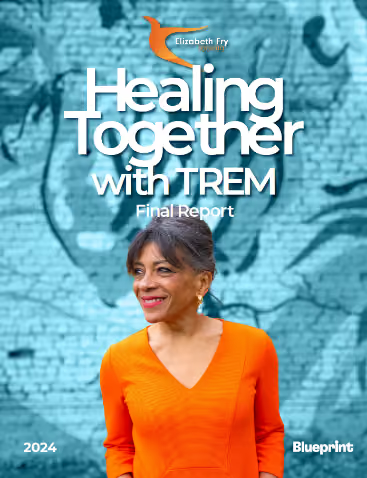
Healing Together with TREM
Elizabeth Fry Toronto adapted the Trauma Recovery and Empowerment Model (TREM) to support women and gender-diverse people who have experienced trauma, gender-based violence, and conflict with the law. Blueprint designed and implemented a multi-year evaluation examining participants’ experiences, recovery outcomes, and how the program was adapted to meet their needs. Our approach combined outcome measurement with participants’ perspectives and staff insights, capturing changes that conventional measures alone might overlook.
The evaluation highlighted the importance of skilled facilitators, supportive peer relationships, and culturally responsive programming. It also examined the challenges of adapting an established intervention, including the shift to virtual delivery during COVID-19. Our findings helped identify opportunities to strengthen program delivery and generated broader lessons about evaluating trauma recovery.
The work demonstrated how evaluation can accommodate complex, non-linear outcomes and produce practical evidence to guide the adaptation and scaling of community-based interventions.
Resources
- Healing Together with TREM: Final Report (2024)
- Healing Together with TREM: Year 4 in Review (2024)
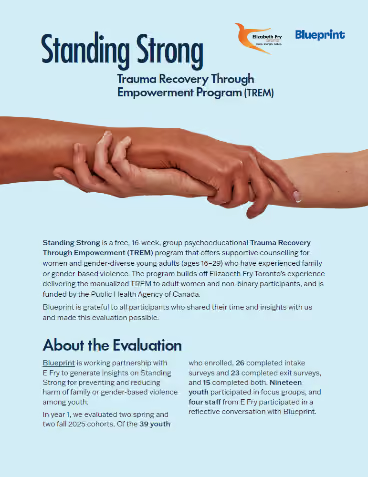
Standing Strong
Standing Strong builds on Elizabeth Fry Toronto’s experience delivering TREM, adapting the model to specifically support young women (aged 16 to 29) and gender-diverse people who have experienced family or gender-based violence. The program combines group-based trauma recovery with individual counselling and opportunities for peer mentorship.
Drawing on lessons from our TREM evaluation, Blueprint developed an evaluation framework to assess how this adapted model works for younger participants, what outcomes they experience, and where improvements may be needed. Our early findings suggest that participants are developing greater emotional awareness and confidence in managing difficult situations. Their experiences also highlight the importance of supportive relationships and trauma-informed facilitation.
As the evaluation progresses, it will also examine training for other service providers, generating further evidence about how trauma-informed interventions can be adapted to different populations and shared more widely.

My Start Up
For women who have experienced mental health or substance use challenges and/or conflict with the law, conventional employment pathways can present significant barriers. Developed by Elizabeth Fry Toronto and Rise Asset Development, My Start Up offered an alternative through entrepreneurship training, mentorship, and wraparound supports.
Blueprint designed and implemented an evaluation examining participants’ progress toward entrepreneurship alongside program accessibility and delivery. In addition to measuring business-related outcomes, we explored how participants’ circumstances shaped their ability to engage with training and pursue economic opportunities. Our findings highlighted the value of peer learning and tailored mentorship, while identifying financial and practical barriers that could limit participation. The evaluation also generated recommendations for improving the program’s structure and supports.
These insights offer practical guidance for organizations and funders designing entrepreneurship programs that better accommodate the circumstances of people facing intersecting barriers to economic opportunity.
Record Suspension Support for Women (ReSUS)
A criminal record can create lasting barriers to employment, housing, and community participation. It can also create a lasting sense of shame and stigma. Although record suspensions can help reduce these obstacles, the application process is often difficult to navigate. Elizabeth Fry Toronto’s ReSUS program provides individualized, trauma-informed support to help people complete this process.
Blueprint designed and implemented an evaluation examining ReSUS’s reach, implementation, and outcomes. Our research explored clients’ experiences navigating record suspension requirements while assessing how effectively the program supported their progress. The findings noted the importance of sustained, individualized assistance, as well as administrative and institutional-level challenges beyond the program’s control.
By examining these systemic challenges alongside program outcomes, Blueprint generated insights relevant to both service delivery and public policy, identifying opportunities to simplify administrative processes and reduce barriers to reintegration.
